Healthcare · Patient Experience
GI Patient Intake
At a glance: Research showed patients wouldn't use the planned desktop email form, so I pivoted intake to an SMS-to-mobile flow. Same-day cancellations fell 30%, completion hit 96%, and nurses got 10 minutes back per procedure.
Nurses were stuck on the phone collecting patient health histories and medication lists before every GI procedure. The process was inefficient, drove burnout and produced high rates of same-day cancellations when critical information arrived late or incomplete.
We wanted to digitize intake to give nurses their time back. The original plan was a standard desktop form sent by email, but I needed to validate whether that actually matched how our patients live their lives.
Intake completion rate on the new SMS-to-mobile flow
96%
Drop in same-day procedure cancellations
30%
Saved per procedure, returned to direct patient care
10 min
Validating the assumptions
I ran competitive analysis, interviewed nurses about the workflow, and interviewed patients about how they'd actually use a digital intake form.
What we learned
- Most patients didn't use a desktop regularly and rarely checked email, but reliably responded to texts
- Listing medications and history is mentally demanding; a long form would get abandoned halfway
What I changed
- Pivoted from email and desktop to a mobile-responsive web app delivered by SMS
.png)
Navigating a constraint: there was internal pressure to stick with email, the standard corporate approach. I used research to show that staying with email would mean significantly lower completion rates, and advocated for the user to shift the team's direction based on evidence, not assumptions.
Mapping the ripple effects
Intake looked like a form, but it was really one node in a care-delivery system. The friction lived back stage, in the nurse phone calls, and cascaded downstream: data arrived late or incomplete, procedures were cancelled same-day, and each cancellation carried real cost.
That reframed the design target from optimizing a form to redesigning a service, where front stage (the patient's phone) and back stage (nurse time and scheduling) had to move together. Moving intake onto the patient's own device was the change that eased the whole chain.
Designing for mobile
Keep it simple
Large buttons, clear text and high contrast so the interface was easy for anyone to navigate.
One step at a time
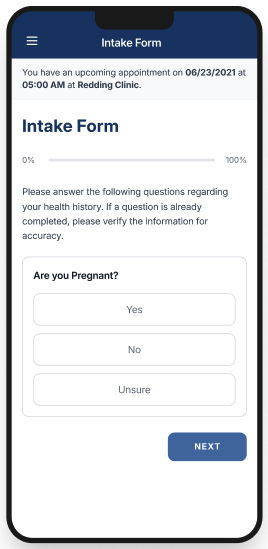
Progressive disclosure broke the long form into small, manageable sections. Patients saw only the next question, never the full scope of the form.
Use plain language
I replaced medical jargon with clear, everyday language so the experience felt approachable and empathetic.
The medication challenge. Letting patients list multiple medications and dosages on a small phone screen was a real UI problem: a basic text input wouldn't work. I iterated on a search-and-select flow that helped patients find their medications quickly while keeping the interface clean.
Intake that meets patients where they are
A secure link arrives by text and opens a clean, mobile-responsive intake app. Progressive disclosure walks patients through one question at a time, a search-and-select flow makes listing medications painless, and plain, provider-branded language builds confidence. Removing the two biggest friction points, finding an email password and navigating a non-mobile site, made it easy for nearly every patient to finish.
Patient · on their phone
The invitation arrives by text
Appointment details and a secure link to a health-history form are sent straight to the patient's phone.
Secure sign-in & intake
The patient signs in securely and completes the Patient Intake form, listing current medications and medical history.
Procedure instructions, instantly
On completion, the patient immediately receives detailed prep instructions specific to their procedure.
Clinical staff · in Apex
Data flows into Apex
Information from the intake form loads automatically into Apex, where clinical staff view and confirm the data, with no re-keying.
 01
01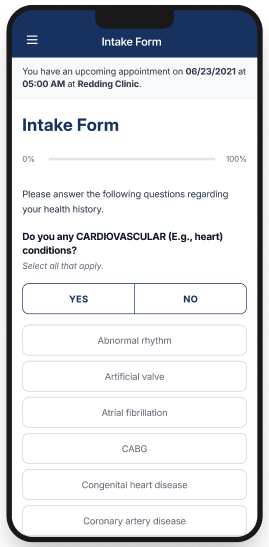 02
02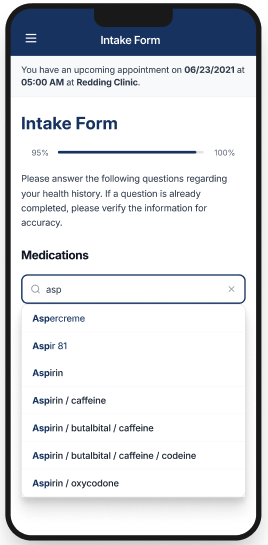 03
03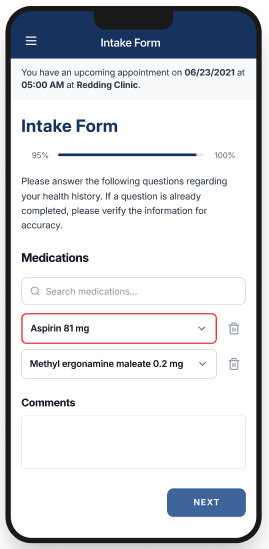 04
04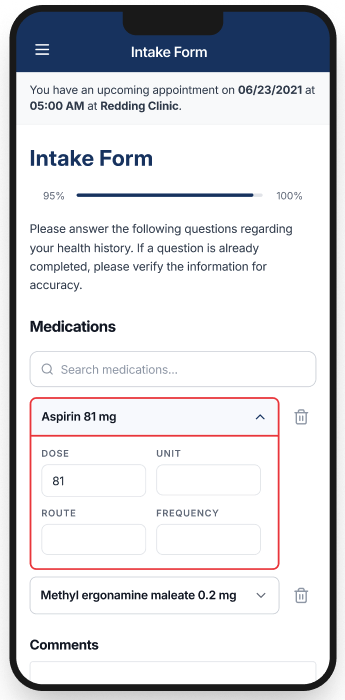 05
05Outcome & reflection
We launched the mobile-first intake system and saw measurable results: nurses saved 10 minutes per procedure that went back to direct patient care, same-day cancellations dropped 30% as complete data arrived on time and we reached a 96% completion rate. The product launched with an expected $700,000 ARR.
The SMS-to-mobile decision proved correct. By removing just two points of friction, we made it easy for nearly every patient to complete intake, proof that meeting people where they are matters more than the channel a team is used to.
What I took away
- Bring the real world into the room. It's easy to assume everyone uses email. My job was to bring research in and challenge assumptions with evidence.
- Small changes create large impact. Removing just two points of friction produced a 96% completion rate. Focus on the barriers that actually stop people, not the features that sound good in meetings.
- Progressive disclosure reduces cognitive load. Breaking a long, complex form into small steps kept patients moving forward. They only ever saw the next question.
- Advocacy is part of the job. When internal pressure pushes a standard solution that won't work for users, research is your strongest tool for shifting the conversation.